Wednesday, April 20, 2011

Epic times in Northern Israel--Day 4

It was with a heavy heart that we finally left Nazareth--the beautiful, lively city was easily the best we had visited so far. We drove north-west to the coast of the Mediterranean Sea, where we first visited the ancient city of Akko (also spelled Acre). Like many other sites already discussed, Akko has a long history stretching through several empires (though most of the monumental buildings are the contributions of the Crusaders). When we reached Akko, we were significantly poorer than we were when we had left Jerusalem, so instead of paying to enter a few of Akko's numerous museums, we wandered through the old city bazaars and churches. We were lucky to catch the head of an Arab-Christian Palm Sunday procession (pictured below). We also ate at Chummus Said, praised by my guidebook (and by the group next to us in line) as the "best chummus in all of northern Israel." Having spoiled ourselves many times at Chummus Lina in Jerusalem's Old City, we were unimpressed.


From Akko, we drove around the bay to Haifa, one of Israel's largest cities. Due to time constraints (our next destination was a national park which closed at 5 p.m.), we did not have time to explore Haifa very thoroughly, but we hit the major highlights. Chief among these highlights were the exquisite Baha'i Gardens (pictured below). Baha'i is a monotheistic religion founded in Persia which preaches the spiritual unity of all mankind--Moses, Jesus, Muhammad, Buddha, and others are all valid divine messengers who preached similar messages of unity and morality. Many of the most important leaders of the Baha'i faith are buried in Akko or in Haifa--Haifa's Baha'i Gardens therefore serve as the "Vatican" of this religion. Visitors are subject to limited visiting hours and a strict code of conduct while admiring the garden (the central Shrine of the Bab--third picture below--is off-limits to non-Baha'i visitors).


We enjoyed a scenic drive through upper Haifa, along the ridge of Mount Carmel. Below is a picture of the city with the sea in the background.


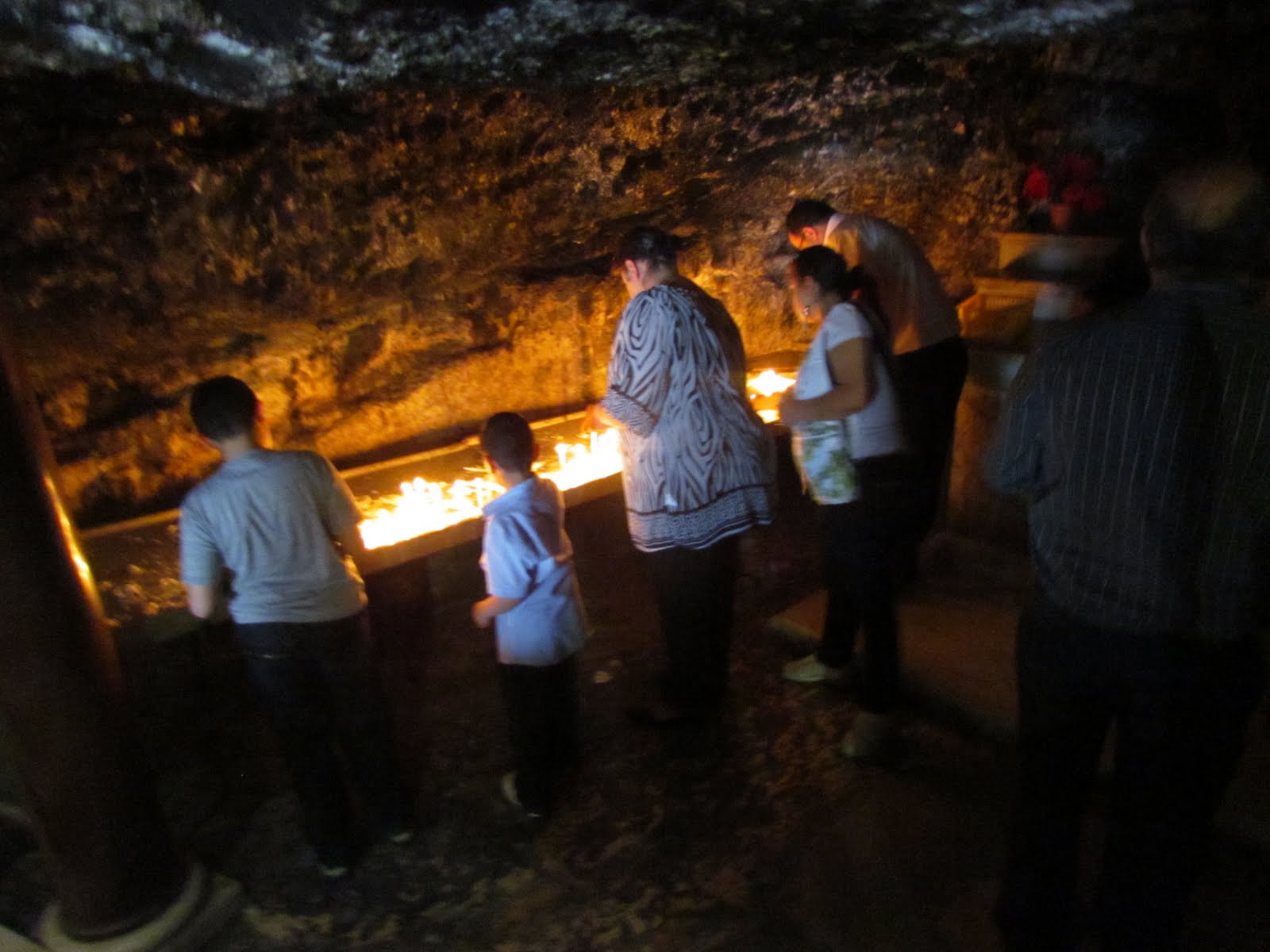
Our last stop in Haifa was to the Carmelite monastery and church (the name of the Carmelite Order is taken from Mt. Carmel, where the order was born). The beautiful, domed church was built atop a cave (preserved beneath the altar, see picture below) in which the Old Testament prophet Elijah is said to have lived.



From Haifa we proceeded southward to Caesarea, the ancient (artificial) port city originally constructed by Herod the Great in the decades before Christ. In its infancy, Caesarea served as Israel's most important maritime city--in the 60s CE, however, strained Jewish-Roman relations in the city resulted in the expulsion of the Jews, an event that ignited the Great Rebellion and the subsequent destruction of Jerusalem in 70 CE. Caesarea passed into Roman, then Byzantine, Muslim, and finally Crusader hands. It was ultimately destroyed by Muslim conquerors. In modern times, Caesarea is an important ongoing archaeological excavation and national park.

Caesarea was similar to Bet She'an--visitors are free to roam about the impressive archaeological remains. Herod's harbor is still visible above the water (first picture below). Roman-style mosaic floors (second picture) are visible in the nobles quarter near Herod's palace. The site contains a (still-operating) Roman amphitheater as well as an arena for chariot races and gladiator battles (third picture below). The final pictures show the remains of a Byzantine church, as well as one of Caesarea's gates.


After an exhausting--but EPIC--four day journey to northern Israel, we returned to Jerusalem. Lucky for us, our spring vacation is not nearly over... we look forward to Passover and Easter in the coming days!

Epic times in Northern Israel--Day 3

Complimentary with our stay at the hostel was a tour of the old city of Nazareth, led by a zany tour guide named Linda. The tour itself was as informative as Linda's personality was completely off-the-wall (in the most hilarious way possible). Here are a number of the Nazareth attractions to which Linda took us on Saturday morning.

1. The White Mosque, a relatively modern mosque in Nazareth, currently constructing a school for Muslim, Jewish, and Christian children. I had never been in a mosque before--note that the room is oriented so that worshipers face Mecca. The pattern on the carpet is meant to apportion uniform floor-space to individuals during prayer.


2. An authentic Arabic coffee shop. We returned to the same shop later in the day and enjoyed some very strong--but very delicious--coffee.


3. A carpenter's shop--not unlike that of St. Joseph. (The woman raising her hand is Linda.)


4. An Arab spice and dried-fruit shop. The store actually sold a number of random items (soaps, beads, etc.). After the tour, we returned to this store for a delicious (and filling) five shekel "taste test." As you can see from the second picture, I'm not a fan of sunscreen.


5. The residence of the local Greek Orthodox bishop, which includes a beautiful chapel (second picture below) and ancient cave, which was the hide-out of a Christian family during an early-first-millennium persecution.


6. An ancient mansion, dated variously from the Crusader period to as early as the Roman era.


After our tour with Linda ended, the three of us detoured to Tel Megiddo. Recall that a "tel" is an artificial mound created by cities which have been ruined and re-constructed on top of one another. The mound, or Mount Megiddo, is called in Hebrew "Har Megiddo," the origin of the (Greek-to-English) word "Armageddon." Early civilizations are attested at Megiddo as early as the Neolithic period (6000 BCE), but the city rose to prominence in the Canaanite period. During this era, Megiddo was the site of a number of bloody battles against both the Egyptians and the Israelites. Eventually, Megiddo came under Israelite control, but the city was captured by the Assyrians in the 700s. In the Bible, Megiddo was the site at which King Josiah was killed; it was also the setting for one of the visions of the prophet Zechariah. In the New Testament, St. John imagines the apocalyptic battle between good and evil to take place at Megiddo, perhaps due to the fact that the city's history was so uniquely war-torn.


Despite the important history of the site, Shiri, Dana, and I found ourselves making up stories about the apocalypse, rather than actually learning about archaeology. The picture below was taken near the ancient stables--I am posing as one of the Horsemen of the Apocalypse. Megiddo DOES boast an impressive underground water system (second picture below).


After Megiddo, we returned to Nazareth to check out the holy sites which had been closed the night before. We began at the Greek Orthodox Church of the Annunciation (first picture below). A baptism was taking place in the ornate interior of the church, which was also being dressed for Palm Sunday. A short tunnel leads from the main hall of the church to a well, which--over and against the so-called Mary's Well outside--claims to be the spot at which Gabriel appeared to Mary.


Down the street, a single gated complex contains two important churches. The first, the Church of St. Joseph, is built over the remains of Joseph's carpentry workshop (some of the original stone work can be seen in the church's crypt). The crypt also preserved the mosaic floors of an earlier, 12th-century church. In the third picture, I am pretending to hammer (you know... like a carpenter?).


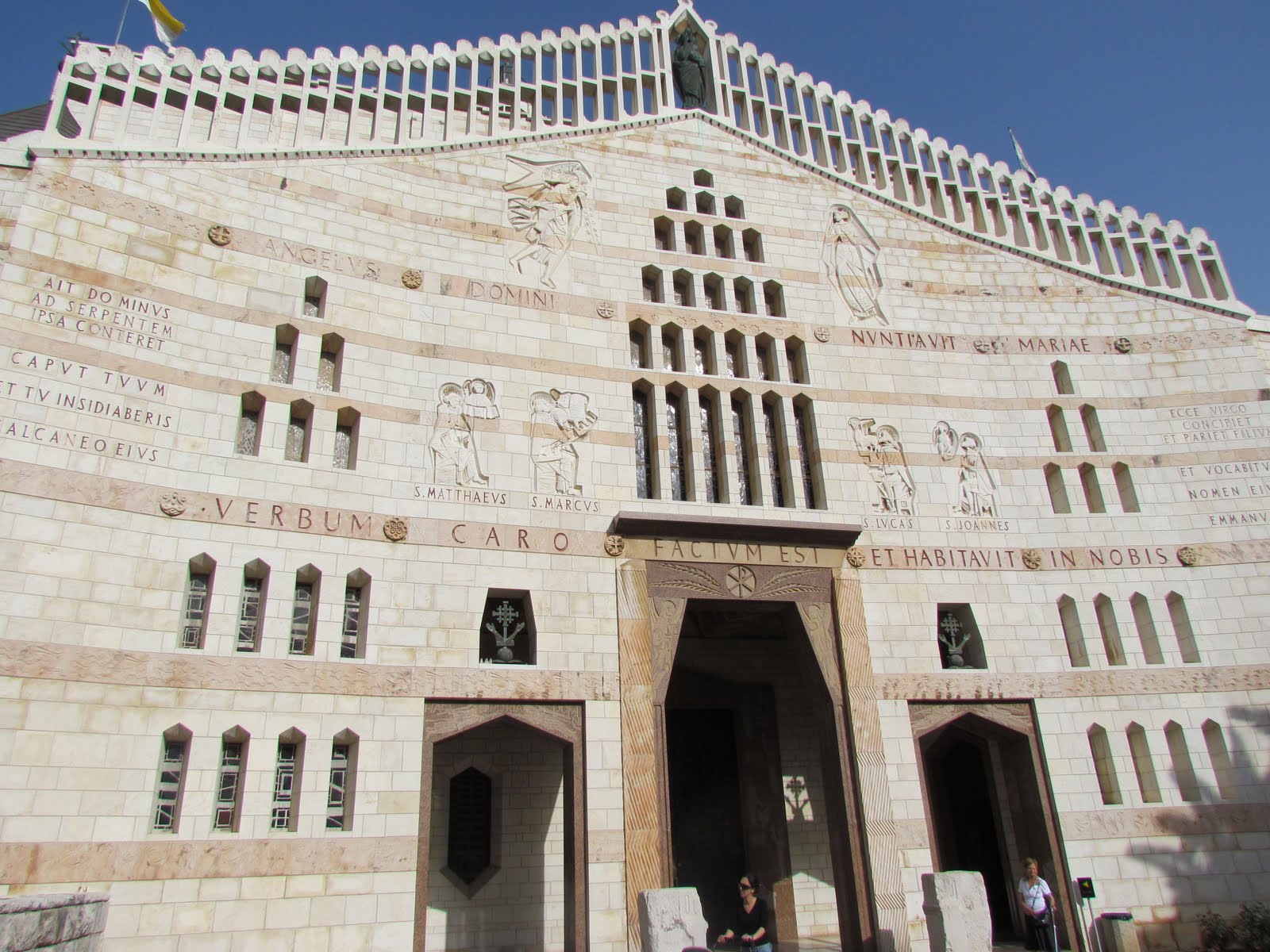
Across a courtyard is the Basilica of the Annunciation, the monumental Franciscan church built upon the site where--this time according to the Catholics--the Annunciation took place. The entrance to the basilica (second picture below) is simply too massive to fit in a single shot. The interior of the church (third picture below) is lavishly decorated--along the side walls are several floor-to-ceiling murals of Mary, created by artists from various countries. The mural from the United States is the fourth picture below.


The Basilica is actually two stories--in front of the main altar (first picture below) is a giant hole from which visitors can peer into the crypt (second picture below). The crypt is built around the grotto in which Mary was supposedly visited by Gabriel (third picture below).


Like the other churches, the Basilica is built upon the remains of older shrines (first picture below)--first Byzantine, then Crusader. The site is believed to have originally been the house of Mary. I've posted a number of other pictures from the Basilica, including the interior of the dome (second picture below), an impressive stained glass window (third picture below), and the magnificent church doors (fourth picture below).


Tuesday, April 19, 2011

Epic times in Northern Israel--Day 2

Our adventure recommenced early on Friday morning, but before continuing on to our next destination, there remained a few more sites to see in Tiberias. First among them was St. Peter's Church, which was unfortunately closed. After begrudgingly picking up our travel-companion, Jocks, we proceeded instead to the Tomb of Maimonides. Maimonides was an extremely important Jewish medieval thinker, something like the Thomas Aquinas of Judaism. The tomb and memorial were beautifully constructed, though I did not dare take a picture inside the synagogue which contains Rambam (abbreviated shorthand for Maimonides)'s remains. Many other important Jewish thinkers were also buried at the site, and I was able to sneak a photograph of two orthodox Jews praying at another tomb.


Having visited the most important rabbi of the medieval period, we proceeded to visit one of the most important rabbis of the tannaitic period (the formative period of rabbinic Judaism), Rabbi Akiva. R. Akiva is one of the rabbis most prominently featured in the Mishnah, one of the most important Jewish texts. Another rabbi's remains--R. Moshe Chaim--are also at this site. Again, I snuck (sneaked?) a picture.


Now well within visiting hours, we returned to the northern shore of the Sea of Galilee to visit the sites which had been closed the previous evening. We began with Capernaum (also spelled Kfar Nahum), the fishing village that was a major site of Jesus' ministry, as well as the home of Simon Peter. The complex is now operated by the Franciscan monastery located on the site. Capernaum houses a beautiful modern church (first picture below), built on top of the remains of an ancient Christian church (second picture below), itself supposedly erected on the foundations of Peter's house. Note that it was near this site that the ancient Galilean boat (see day 1) was discovered.


Capernaum also contained the impressive remains of a 4th-century Roman-style synagogue, pictured below.


From Capernaum, we drove to the village of Tabgha, which sports two important churches--the Church of the Multiplication and the Church of the Primacy of Peter. The Church of the Multiplication (first picture below) is venerated as the site at which Jesus fed the masses; the rock below the altar (second picture below) is thought to be that upon which Jesus laid the surplus of food. Notice the ancient mosaic floors!


The Church of the Primacy of Peter commemorates Simon Peter's special place of honor among the apostles (interpreted in the Roman Catholic tradition as proof for the authority of the Pope). The church altar is built atop another stone alternatively thought to be that upon which Jesus laid the multiplied food. This church is also associated with one of Jesus' resurrection appearances. The second picture below is the exterior of the church; the third is Shiri attempting (though unsuccessfully) to walk on water.


From the Primacy of Peter, we ascended to the Church of the Beatitudes, where Jesus delivered his most famous sermon ("blessed are the poor..." etc.). The only thing more stunning than the church itself was its impressive grounds, consisting of well-groomed gardens overlooking the Sea of Galilee.


Santi next took us to Tsfat (also called Safed), one of the holiest cities in Judaism and the birthplace of Kabbalah, Jewish mysticism. As the highest city in all of Israel, Tsfat was great for photographs. We began at the citadel (first picture below) which overlooked the sprawling, very religious city.


We spent most of our time in Tsfat in the sleepy Artist's Quarter, a formerly-Arab neighborhood that is now home to a number of painters (also sculptors and jewelers) and their studios (pictured below). The area was not unlike Old Jaffa. Most studios were closed in lieu of the impending Shabbat, but a few were open, and Shiri, Dana and I enjoyed admiring the spectacular paintings (Jocks was not so enthusiastic). We bought a few small prints to support the artists.


By this time, Jocks had overstayed his welcome, and mercifully, he remained in Tsfat while we continued on to Nazareth. Nazareth was, of course, the biblical home of Jesus, but today is a large, energetic Arab city. Our hostel, in the old city of Nazareth was a restored 19th-century mansion. The reception room, with its hand-painted ceiling, are pictured below.


Most of the holy sites of Nazareth were closed by the time we got to the city, but on our way to dinner, we stumbled upon Mary's Well, the ancient spring at which it is believed the angel Gabriel appeared to the Virgin Mary and announced that she would conceive. (Two other churches--see the forthcoming post for day 3--also claim to contain the site of the Annunciation.) Unfortunately, Mary's Well was tagged with Arabic graffiti.


After dinner, Dana, Shiri, and I sampled baklavah from the famous Arab sweet-shop located outside of the old city. As you can guess from the picture below, it was absolutely delicious.